
Reviewed · LUCERNE CITY TOURS
Private Classic Lucerne City Walk
Lucerne is a small city that packs big stories into a tight route, and this private walk is a smart way to see the best of it without wrestling with directions. I like that it feels personal, yet it still moves briskly from stop to stop, and the guide (often Ralf) explains the meaning behind what you’re standing next to. You also get hotel pickup plus built-in time savers like prebooked entry for Ritter Palace.
My favorite parts are the views from the Musegg Wall and the way the old town’s details click into place once you know what to look for, from Hirschenplatz house paintings to the clock at Kornmarkt. One drawback to plan for is that two key sights have seasonal or calendar closures, so part of the route may shift from inside visits to outside viewing.
Quick hits before you go
- Door-to-door hotel pickup within Lucerne city limits, or pickup by the main station arch
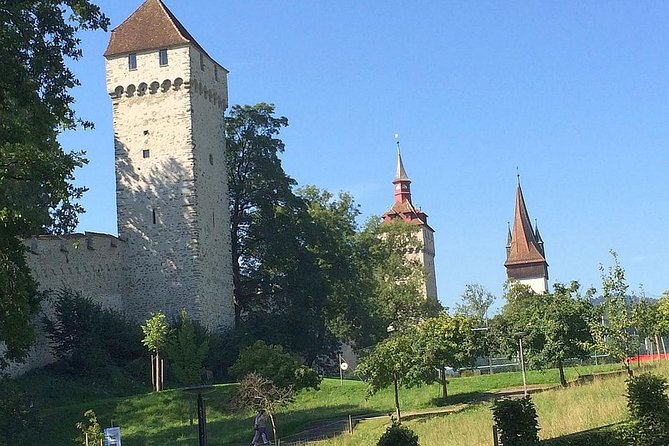
- Musegg Wall and Tower climbs with a clock-tower ascent and city, Alps, and midland views
- Ritter Palace interior visit when open, guided through Danse Macabre paintings by Jakob von Wyl
- Old Town squares with specific details, like Kornmarkt’s clock without a minute hand and tasting spring water at the oldest fountain
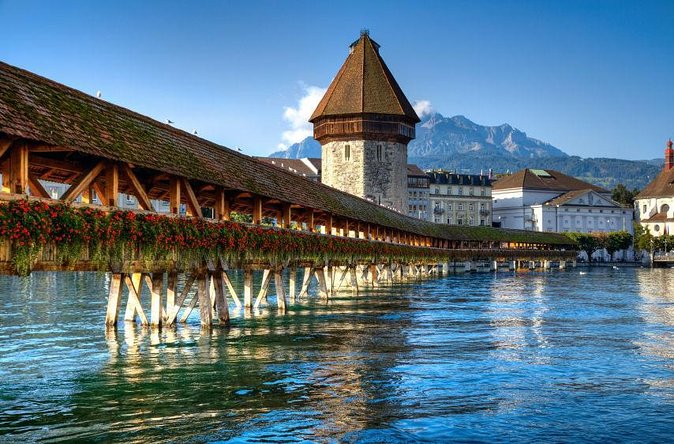
- Iconic waterfront stops including Chapel Bridge and the Water Tower’s prison connection
- Winter and weekend adjustments, with Musegg Wall and Ritter Palace sometimes outside-only
Lucerne in 2 Hours, Without the Stress of Finding Things
This is a classic “get your bearings fast” tour, but not in a rushed, checklist way. You’re moving through Lucerne’s core on foot, with short bus hops when it makes sense, and every stop is chosen because it connects to something you can actually see on the street. That matters in a town where half the charm is in facades, bridges, and the way streets climb and curve.
The pacing also feels practical. The route is built around short time windows at most highlights, then a longer stretch up to the Musegg hill. If you want a tour that gives you context for your next two or three days, this does that well.
A private format is a big part of the value here. You’re not competing with strangers for hearing distance at the Lion Monument, and your guide can adjust timing if you have other plans. If your group has mixed ages, the walking plan is mostly manageable, with only one real uphill push.
More Lucerne city tours:
- Lucerne: Private Walking Tour with a Local Guide
★ 4.6 · 450 reviews - Lucerne Walking & Boat Tour: The Best Swiss Experience
★ 4.5 · 417 reviews - Lucerne: Guided Walking Tour with an Official Guide
★ 4.7 · 321 reviews
Hotel Pickup, Local Transit Tricks, and What’s Included in the Real World
One of the biggest wins is the pickup system. You can be collected from any Lucerne hotel within city limits, or from the large arch at Lucerne main station. If you want to keep things simple, you can choose the option to advise your pickup place later, and you’ll still get a clear start.
During the walk, you may take a public bus segment early on, heading toward Lion Square. The good news is that transport can be free for Lucerne overnight guests, as long as you have your Visitor Card from your hotel reception. If you are not using the free transit benefit, a public transportation ticket is not included, so you’ll want to be ready for that.
In terms of what you actually pay for, the price includes a professional local guide, the private format, pickup and drop-off within the city, and all taxes and handling charges. You also get three exclusive post cards featuring Old Lucerne, which is a small but genuinely useful souvenir if you like to send something home that doesn’t feel generic.
You should also know that this runs in all weather conditions. That doesn’t mean it’s a muddy ordeal, but it does mean you should pack a rain layer and good walking shoes. If the skies are grey, at least the history and views still work.
Bourbaki Panorama to Lion Monument, History You Can Stand On
The tour begins right where you are, with your guide meeting you in your Lucerne hotel lobby. After a quick introduction and a route map, you’ll either walk or take the public bus to Lion Square. This first segment helps you avoid the common tourist problem: arriving at Lucerne and spending the morning trying to figure out where everything is.
Stop one is the Bourbaki Panorama area. You see the Bourbaki Museum from the outside and get a short overview of the story behind it. Even without going inside, you’re placed in the right spot to connect the name to the local setting. It’s a good way to introduce Lucerne’s habit of turning big events into something you can experience in layers.
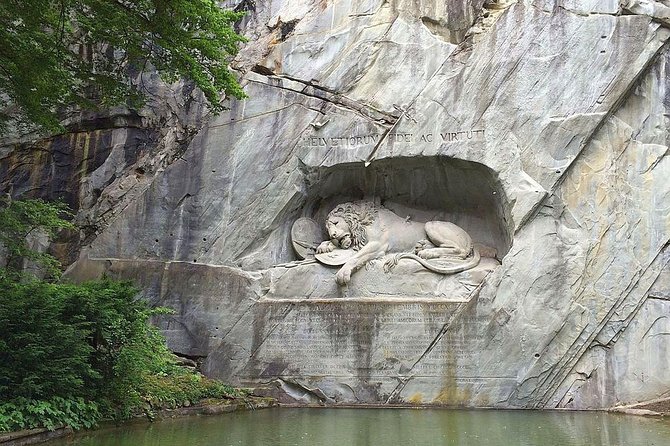
Then you move to Lion Monument, a few steps away. This is one of Lucerne’s most powerful symbols, commemorating the fallen Swiss Guards during the French Revolution. The guide frames it in a timeline you can actually picture: Swiss Guards were common with European rulers, then the French Revolution begins in 1789, and three years later the Paris mob attacks the French King’s palace, with about 800 Swiss Guards killed in action.
What I like about this stop is how it connects medieval identity and modern political upheaval. Even if you only catch a part of the story, the monument itself does the emotional work for you. It’s also quick, so you’re not stuck lingering too long before moving into the more walkable Old Town pieces.
Musegg Wall and the Clock Tower Climb: Views That Reward the Steps
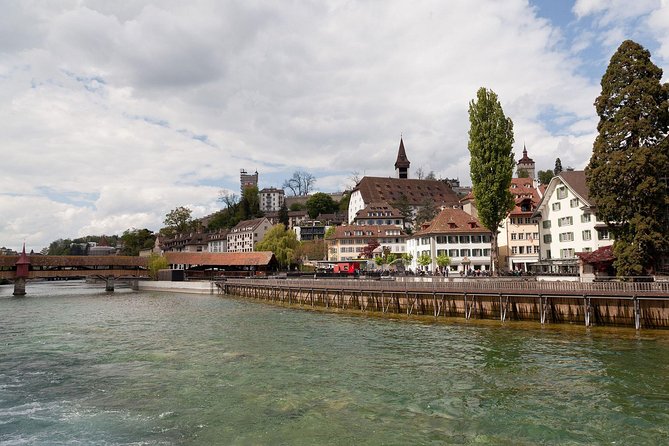
This is the most active part of the route. You take a leisurely uphill walk for about ten minutes to reach the Musegg hill. From there, you visit two sections of the Musegg Wall and Towers, plus a climb up the Schirmertower. You also get a walk along the defense walk and then an ascent to the top of the Clock Tower.
It’s not just a view stop. This is where you start to understand how Lucerne defended itself and how the city’s shape grew around that fortification line. The guide’s explanations make the wall feel less like a photo backdrop and more like a working system.
At the top, the reward is the panorama. You get views over the city, the Alps, and the midland. That mix matters, because Lucerne is often photographed as a lakeside city, but from here you see it as a hub between mountains and plains.
Two planning notes are important. From November to March, the Musegg Wall and Towers are closed, and you can only view them from the outside. If you’re traveling in winter and want the full climb, you may need to adjust expectations ahead of time. On open months, bring a little patience for the stair steps, and you’ll likely feel like your effort was worth it.
A few more Lucerne trips worth comparing
- Lucerne: Walking and Boat Tour with Cheese & Wine Tasting
★ 4.7 · 120 reviews - Exclusive Private Lucerne Walking Tour with Local Guide 3 Hours
★ 5.0 · 80 reviews - Lucerne: Private Walking Tour with a Local Guide
★ 4.2 · 34 reviews - 1.5-Hour Small-Group Nightwatchman Walk in Medieval Lucerne
★ 4.5 · 34 reviews
Hirschenplatz to Kornmarkt: Medieval Facades and a Clock With No Minute Hand
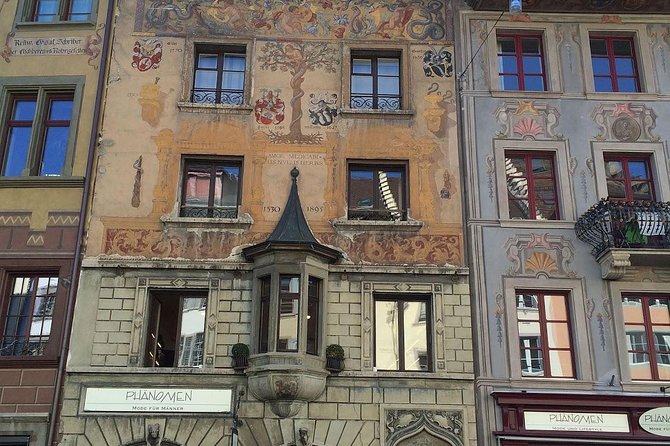
Once you leave the fortified hill area, you drop into the heart of Old Town. Stop four is Hirschenplatz, the Stag Square, where you see medieval houses with facade paintings. These aren’t random decorations. They’re part of Lucerne’s long tradition of marking buildings with symbols and visuals that helped identify streets and status long before signage was a thing.
Then you continue to Kornmarkt, the Town Hall Square. Here you see the town hall and tower dating back to the early 17th century. The big detail is the clock, famous for doing without a minute hand. If you’re used to precise timekeeping, this is a fun reality check that public clocks used to serve different needs, and not every town wanted the same level of granularity.
Next is a short hop to Weinmarkt, which was once called the Fish Market. This area is also where you learn why the old city fountains carry spring water that locals trust, and you get to taste it yourself at the oldest fountain in the city.
This combo is why I think the route is smart. You’re seeing architecture, then you’re hearing why the public spaces mattered, then you’re doing the hands-on thing with the fountain water. Even people who think they are not into “old buildings” usually enjoy the practical, test-it-yourself moment.
Reussbrücke and the River Angles That People Skip
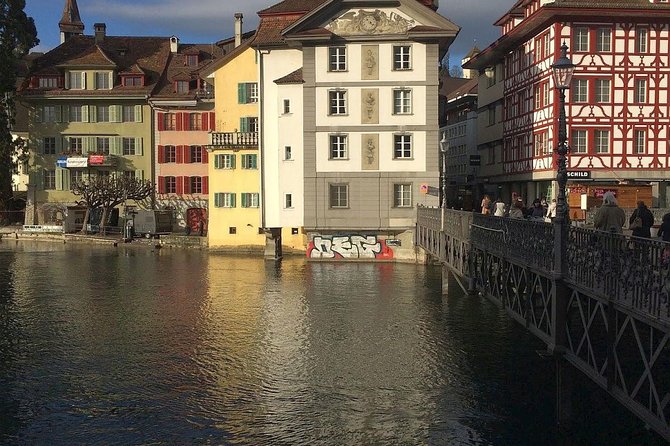
From Weinmarkt, you pass the lower wine market area where a pillory once stood. Then you cross the river on Reussbrücke. This isn’t just a bridge walk. It’s a quick repositioning that gives you new angles on the town.
Along the way, you see the Reuss river and the needle dam, plus the mill bridge called Spreuerbrücke. You can also spot two of the Musegg towers from this side of the river, which is a nice way to visually connect your earlier uphill climb with what you’re seeing now.
One subtle benefit of crossing here is how it resets your attention. You go from squares and facades to movement and water, and it makes the city feel larger than it is. It also sets you up for the interior stop at Ritter Palace, because you arrive with a little momentum but not exhaustion.
Ritter Palace and Danse Macabre: The Inside Stop Worth Planning For
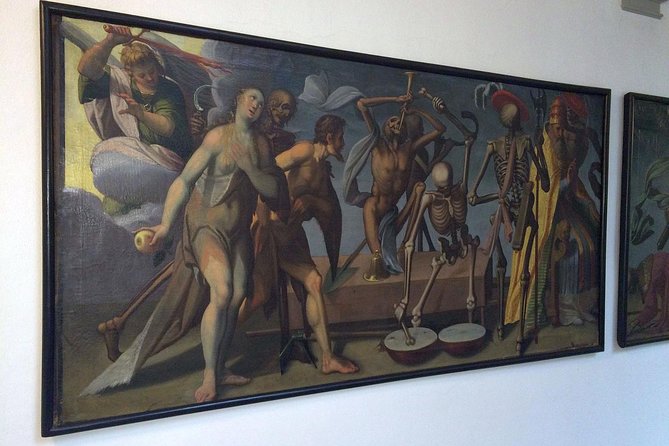
Ritterscher Palast is one of the highlights because you go inside. You’ll learn about the history of this florentine Palazzo from the 16th century, and then you’re guided through the Danse Macabre gallery. The gallery features seven paintings by Jakob von Wyl, and the guide’s explanation helps you see how the artwork fits into its time, not just as decorative oddities.
This stop is a big value point for the tour. The overall highlights mention that you save time with a prebooked admission ticket, which matters in a city where entry rules and opening hours can be fiddly.
There is a key caveat. On Saturdays, Sundays, holidays, and special events, Ritter Palace is closed. In that case, you can visit it from the outside only. You still get the place in your route, but you lose the guided interior content, and that’s usually the part people remember most.
If you’re flexible with day choice, it’s worth aiming for a day when the palace is open. If you are traveling on a day when it’s closed, treat this as a “plan B” day and ask your guide for the best nearby alternatives, since the tour includes time to keep things moving.
Jesuit Church, Chapel Bridge, and Why the Bridge Name Matters
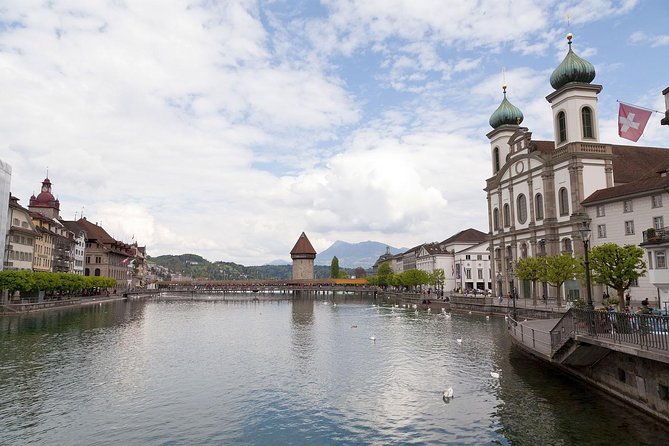
Next you visit the 17th century Jesuit Church. It’s described as the first Baroque church in Switzerland, and the guide gives you the story behind it before you have the option to enter. Inside visits can be restricted during mass services, so if you arrive during a service, you may need to enjoy it from your viewing window instead.
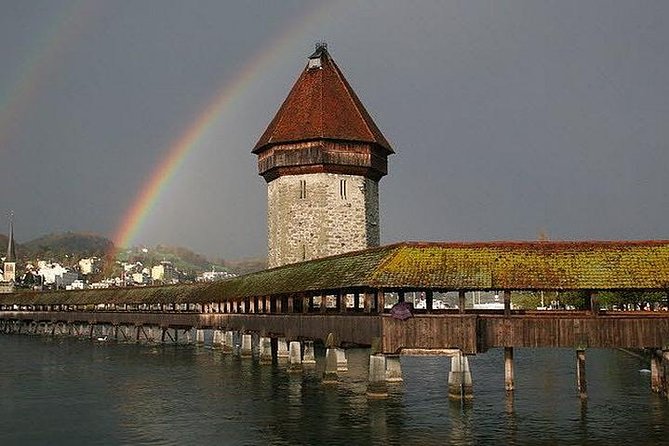
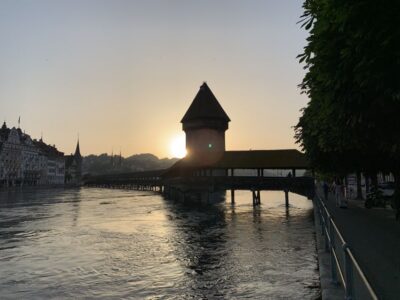
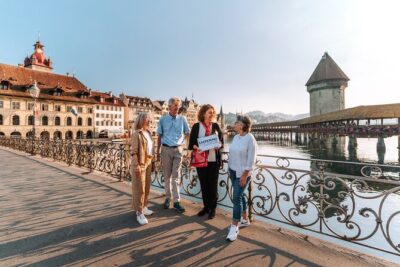
After that comes Chapel Bridge, the famous Kapellbrücke, with its Water Tower. The tour includes the history of the bridge as a former city fortification bridge, plus details about the paintings and the Water Tower’s earlier function. The Water Tower once used to be a prison, which gives the structure an edge beyond the postcard version.
Then you finish at Rosengart Platz next to St. Peters Chapel, the first church in town dating back to the 12th century. You also see the Zur Gilgen House, the first private stone house in Lucerne from the early 16th century. Finally, the guide ties the route together by explaining why Chapel Bridge is called Chapel Bridge.
This last stretch is a neat trick. You start with big story markers like Lion Square and the Swiss Guards, then you move through fortifications, civic squares, and palaces, and you end with religious architecture that explains place names. It helps you leave with a city that feels coherent.
How Good Is the Guide, Really?
The reviews attached to this tour are strongly aligned on one theme: the guide makes the difference. A name you may see is Ralf, and the common compliments are about clear speaking, strong city context, and good control of pace.
One detail that stands out is schedule timing around the Musegg Clock Tower climb. In at least one version of the experience, the walk was timed so an hourly clock moment lined up with the ascent. That’s not something every guide will think about, and it’s exactly the kind of small, experience-shaping touch that turns a climb into a memory.
Another repeated point is adaptability. If you have another plan that day, the guide can adjust the route timing and still get you to the major highlights. That matters because Lucerne days are easy to overload with boat rides, lake views, and cable cars.
Also, the tour works well for family groups. One review called it easy walking for older members and little kids, which tells me the route is paced with real people in mind, not just tour-bus endurance athletes. If your group includes mixed mobility, you’ll likely appreciate that you’re not dumped into one long slog without checks.
Price and Value: What $198 Buys You in Lucerne
At $198 per person for a private 2-hour walk, you’re paying for three things: time, expertise, and convenience. The convenience piece is real, because pickup and drop-off removes the most annoying part of sightseeing in a compact city: meeting points.
The expertise piece is what you feel at stops like Lion Monument and the Danse Macabre gallery. You’re not just reading plaques. You’re getting the story that makes the monument and paintings make sense, so your brain doesn’t have to do all the work later.
The time piece is partly about prebooked entry for Ritter Palace. If you’ve ever tried to time an Old Town interior visit on your own, you know how often the day’s schedule collapses into last-minute compromises. Here, that friction is reduced.
Still, it’s not “cheap.” If you are traveling solo or with someone who doesn’t care about guided context, you might prefer a self-guided walk. But if you want your first taste of Lucerne to feel informed and efficient, the private format justifies the price fast.
Who Should Book This Private Classic Lucerne Walk?
This tour fits best if you want a guided highlights route that still feels human. It’s ideal for first-time visitors who want a tight framework for the city, and it’s also great for people who want to focus on quality stops rather than covering every street.
It’s especially good if you care about history that has physical anchors. Lion Monument, Musegg Wall, Chapel Bridge, and the Ritter Palace gallery are all places where the story lives in the building or sculpture, not just in a lecture.
If you’re traveling in winter (November to March), remember Musegg Wall and Towers are closed and only visible from the outside. If your trip lands on a Saturday, Sunday, holiday, or special event, Ritter Palace may also be outside-only. You can still enjoy the route, but your “inside content” may be reduced.
Should You Book This Private Lucerne Walk?
Yes, if your goal is a confident first look at Lucerne in about two hours, with hotel pickup and an actual guided story at the key sights. I’d also book it if you like structure, because the route hits the most recognizable Old Town landmarks plus a couple of details you might miss, like Kornmarkt’s minute-hand-free clock and the fountain water tasting.
I’d think twice if you only want a casual stroll and you’d rather spend that time doing something independent like a lake walk or a boat ride. Also, check your calendar if Ritter Palace and Musegg Towers opening hours matter to you most, since those closures can change the feel of the tour.
FAQ
How long is the Private Classic Lucerne City Walk?
It lasts about 2 hours.
Is this tour private, and who will be with my group?
It is a private tour/activity, so only your group participates.
Do I get picked up from my hotel?
Yes, pickup is offered from any Lucerne hotel within the city limits, or you can be picked up at the big arch right at Lucerne main station.
Is public transportation included?
A public transportation ticket is not included if applicable. If you stay in a Lucerne hotel, you are entitled to free public transportation during your entire stay, and you should bring your Visitor Card.
Are admission tickets included for the sights?
Admission tickets are listed as free for the stops. The Ritter Palace is an inside visit when it is open, with a prebooked admission ticket mentioned as a time saver.
What happens if I travel in winter or on weekends?
From November to March, the Musegg Wall and Towers are closed and can be visited from the outside only. On Saturdays, Sundays, holidays, and special events, Ritter Palace is closed and can be visited from the outside only.
What is the cancellation policy?
You can cancel for free up to 24 hours in advance for a full refund. If you cancel less than 24 hours before the start time, the amount paid is not refunded.
Recently reviewed around Lucerne
- Zurich: Day trip to Lucerne and Bürgenstock★ 3.7 · 12 reviews
- Zurich: Adventure to Lucerne & Pilatus Gold or Silver tour★ 4.8 · 8 reviews
- Private Transfer: Lucerne to Zurich Airport ZRH by Business Car★ 5.0 · 11 reviews
- Private Transfer: Lucerne to Zurich Airport ZRH by Luxury Van★ 4.5 · 6 reviews
- Weggis Vitznau Foxtrail Helios★ 4.5 · 8 reviews
- Natural Wonders of Switzerland from Lucerne (1 Day Private Tour)★ 5.0 · 21 reviews
- Touristic highlights of Lucerne on a Private half day tour with a local★ 4.0 · 5 reviews
- The Lives and Legends of Lucerne: A Self-Guided Audio Tour★ 5.0 · 6 reviews
Lucerne City Tours, side by side.
Lucerne Walking & Boat Tour: The Best Swiss Experience
Read our review →

Walking and Boat Tour with Cheese & Wine Tasting
Read our review →
Lists this tour appears in